K Center Workshop and Interview Log, Session 1, February 2, 2026
Facilitator: Hyejung Son
Recorder: Goeun Jeon
Participants: 8 people, attendance checked separately
1. Orientation
Explanation of the interview content and purpose for the Shimcheonggil performance
The performance will be created as an original work reflecting our own stories.
Performance date: June. Participants may volunteer to take part.
2. Activity 1, Greeting Through the Body
Participants greeted one another by touching finger bones, shoulders, elbows, knees, and other body parts together.
Reflections on the activity:
The awkwardness disappeared, and participants felt closer to one another. It felt like a barrier had been removed. The body felt relaxed. Many people were smiling.
3. Activity 2, Expressing Objects Through the Body
Participants paired up, and one person gave posture instructions to the other person to express an object.
They expressed various objects, including a watering can, scissors, a tree, a chair, and a ball.
4. Video Viewing
Participants watched a video of Shimcheonggil Secret Recipe, which had been performed in Korea.
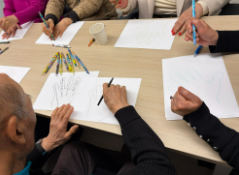
5. Activity 3, Drawing Hands
Participants drew their own hands and wrote emotions on each finger.
- When they felt joy, excitement, anger, sadness, and one other emotion
- Foods that come to mind when they feel joy, excitement, anger, sadness, and fear
6. Story Sharing
Food That Comes to Mind When Feeling Afraid
<Lee>**
For me, it is pumpkin porridge. When I was going through a hard time, someone made pumpkin porridge and brought it to me, and I cannot forget that. I was sick, and I thought, I guess I am just going to die now. My body hurt, and I had no strength. When I thought, now I am going to die, I felt scared and afraid. At that time, someone I knew made pumpkin porridge and gave it to me. After eating it, I gained strength and my body recovered. I think of that pumpkin porridge that helped me recover from my fear.
<Gu>**
I think of castella. I first ate castella when I was in college, and it was so soft, sweet, and delicious. If something scary happened, I feel like eating castella would make that fear disappear completely.
Others:
That is right. Castella was really delicious back then. These days, it tastes different from that time. When you eat castella now, it feels dry and does not have the same taste as before.
<Bae>**
I think if I eat candy or chocolate, the sweetness might help me forget my fear. Actually, something happened once. My daughter took me on a trip to 000. While we were sightseeing, we went into a shopping mall. Suddenly, an employee said that someone had come in with a gun and told us to hide quickly. So we went into a space, turned off the lights, and hid. My heart was shaking so much at that moment. My daughter gave me chocolate and told me, “Mom, it will be okay.”
K Center Workshop and Interview Log, Session 2
Facilitator: Hyejung Son
Recorder: Goeun Jeon
Photos: Yejoo Kwon
Video: Gaon Lee
Participants: 9 people, attendance checked separately

<Yeon>**
When I feel sad, rather than food, I think of just drinking coffee… The saddest moment of my life… When I first immigrated, I came to Maryland. My husband was an international student, and then we moved to LA. He finished his studies there. We were living like that, and when I was 48 years old. It was Christmas, Christmas, and we had a big business. Guests had come from Korea, so we prepared everything very well. Since it was the second part of Christmas, I asked, when are you coming in? He said he would come in about an hour. But he did not come in even overnight. He must have been somewhere else… (omitted)
<Moon>**
I was someone who had made up my mind not to get married. But because I was not getting married for so long, rumors started coming into the house, and even matchmaking did not work out. Things were not working. Since I had already decided inside myself that I would not get married, but I did not say that out loud, I thought that going to America was the only solution. So I came to America, and before I even got on the plane to go back home after finishing all the studies I wanted to do, I decided to marry someone I had not even dated.
Because the subject I studied was child development. I am also from a teachers’ college, literature. So I taught for a long time. In Korea, those teachers were so strange. They would call unmarried women into the teachers’ room. The day before, in a big room, all the teachers would be sitting together. During break time, they called in second-year high school girls, and in front of many people, the teacher sat with his legs crossed and scolded the students… (omitted)
<Jung>**
When I am happy, I usually eat tangsuyuk. I like it. And for when I feel excited, I wrote jajangmyeon, but actually, that is also something I eat together when I am happy.
And also, when was I happy? The happiest times were when I met my wife and got married, and when I received an honor award at my high school graduation.
That was especially because I attended a teachers’ high school, a high school program where I could receive an elementary school teacher’s certificate. But I was the last class.

<Soon>**
I will briefly talk about when I was 13 years old, during the Korean War, when we suffered because we had so little to eat. We lived in Anseong, Gyeonggi-do. During the January 4th Retreat, my older sister and I, my two uncles, and our nieces and nephews on our backs, and my aunt was full-term pregnant. We evacuated like that. But my aunt had to give birth, so in Jincheon we went into someone’s house and she gave birth there. There was no other way, so she gave birth there… (omitted)
<Choon>**
When I think of my father… (She cannot continue speaking for a while and begins to cry.) I will talk about my father. We lived in the countryside, and there, we could not eat things like meat. But after I got married and moved to Seoul, I ate a lot of meat. Whenever I ate meat, I thought of my father so much. It is still the same even now. Whenever I eat meat, I think of my father. My father was someone who would always say food was delicious whenever he ate, but he never got to eat meat… Since we were poor in the countryside at that time, he could not even eat meat properly. Even now, I think of my father so, so much… I really think, how nice it would have been if my father had been able to eat some meat back then. (omitted)
<Mi>**
When I think of mul-naengmyeon, sadness comes to me. After my husband passed away, I could not eat food, so my older sister asked me to tell her what I wanted to eat. But I had no thought at all of wanting to eat anything, so I kept not being able to eat. (omitted)
<Hye>**
For me, it is peaches. You know white peaches. The Korean kind that are a little firm, not too soft, that you can either peel and eat or bite into. One day, my mother and I went to a traditional market, and when she saw the peaches, she said, “Those peaches look so delicious.” She wanted to buy them, but then she said we did not have enough money, so we could not buy the peaches. Since we had bought various things at the market, we were short on cash. My mother liked peaches the most. So I said, “Mom, we can come tomorrow or the day after tomorrow and buy peaches.” Then we went home. And three days later, it was Liberation Day. My nephew was studying in America, and he had come to Korea briefly and had to leave again. His flight was at 11 a.m. (omitted)
<Young>**
My husband passed away when he was 53.
He passed away suddenly from a heart attack. We had not prepared anything, and I had only been taking care of the household at home…
When I am sad, I think of traditional yakgwa, something sweet. When I eat that, something changes a little, and my heart settles down a bit. It is something I like. If I eat a little bit of that food, it relieves it somewhat. (omitted)
<Sung>**
I gave birth to a daughter, and people said it was bad luck. I did not like daughters.
“That makes me sad. I am also a daughter. Why did you dislike daughters?” asked the interviewer.
In my parents’ home, I was raised very preciously, but after me, my mother kept giving birth to daughters, six daughters. When I went to the well, people would ask me, “What did your mother give birth to?” Then I would say, “She gave birth to a daughter.” People would click their tongues and say, “Another daughter? Your family had another daughter?” So maybe that is why I disliked daughters. I think that was it. I disliked daughters. (omitted)
K Center Workshop and Interview Log, Session 3, February 9, 2026
Participants: 4 people, attendance checked separately
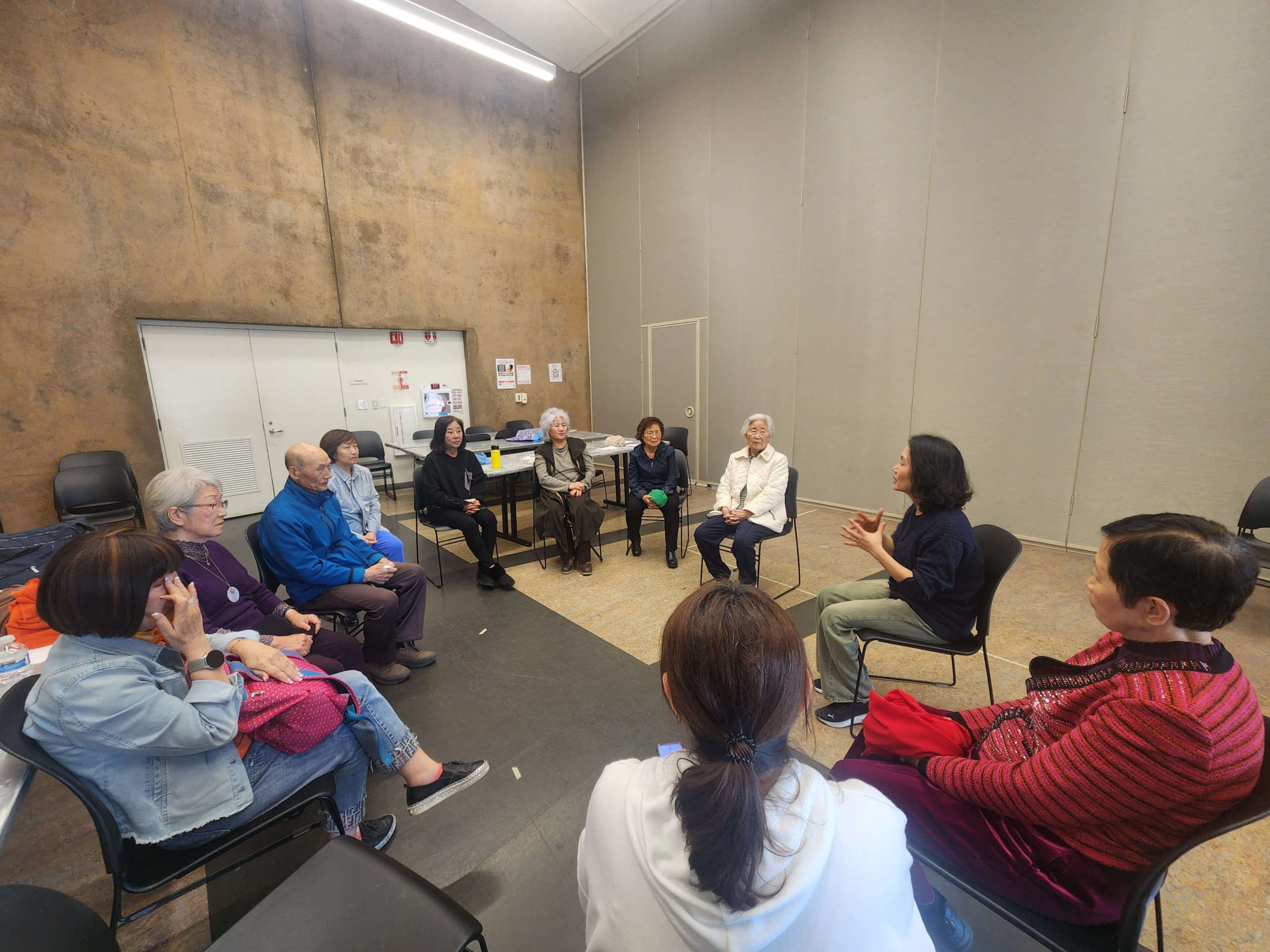
One-on-One In-Depth Interviews
While the one-on-one interviews were being conducted, the other participants shared refreshments and continued additional interviews. The following are excerpts from parts of the interviews.
<Im>**
“Here, in order to earn a living and feed yourself, the first thing you have to do is drive. Everything is in English. So I just memorized those words all night long. I did not even know the content. I just memorized the words. I memorized them, took the test, passed, and got my driver’s license.”
“At the electronics company, after I entered and somehow kept going, I came up from the very bottom and, even though I was not very good, I made it up to Final QC.”
“I miss my childhood so much. When I was in elementary school. I think it was good back then because I did not know anything. I knew nothing, and I was just happy for no reason.”
<Kim>**
“For the first time in my life, I was away from my husband and went on a cruise with friends, about five or eight of us. Really. I was so happy. It was the first time in my life.”
“I thought America would be very brilliant, with tall buildings and houses, but it was completely like countryside houses. So I was really surprised and disappointed. At first, I felt that way, but when I heard that the houses could not be built high because of earthquakes, I understood.”
“When I was going to take the citizenship test, a Korean person told me, ‘Since you are Korean, wear hanbok.’ So I said, ‘Why would I wear hanbok? It is cumbersome.’ But they said I needed to look good to the people giving the test. So I really put on hanbok, dressed up nicely…”
<Moon>**
“I had all of them study here, and I came after marrying off my son. In 1998, my daughter graduated from college here. So here, in Cupertino, what was it, Santa Vesca or something, I am not sure. She had graduated from high school there. At that time, my husband came, and when she was about to graduate from college, I came. After that, my son was discharged from the military and came to study abroad right away. Two years later, my youngest daughter came too. So I had all three of them study here.
I served as a nursing officer for about 14 years, and for nursing officers, there is a rotation between the first and second half.”
<Gu>**
“From the beginning, from when I was young, I had a vague dream that somehow I would go abroad and live there one day. I had that dream, but I thought the chances of it actually coming true were slim.”
“Then, a little after the mid-1980s, travel started to become a bit freer. As trade turned into a surplus, it became possible to study abroad at one’s own expense. So I kept encouraging my younger sibling to go study abroad, and they went to America.”
“Three graduating student representatives came forward and spoke about their hopes and visions for the future, and that was very impressive. And they called each graduate by name and personally gave each person their diploma. I felt that those things were different.”
K Center Workshop and Interview Log, Session 4, February 12, 2026
Participants: 4 people, attendance checked separately
Facilitator: Hyejung Son
Recorder: Goeun Jeon
Photography: Yejoo Kwon
Conducted Simultaneously in Separate Parts
1. Activity, Drawing Hands: Additional Activity for Those Who Could Not Participate Last Time
Participants drew their own hands and wrote emotions on each finger.
- When they felt joy, excitement, anger, sadness, and one other emotion
- Foods that come to mind when they feel joy, excitement, anger, sadness, and fear
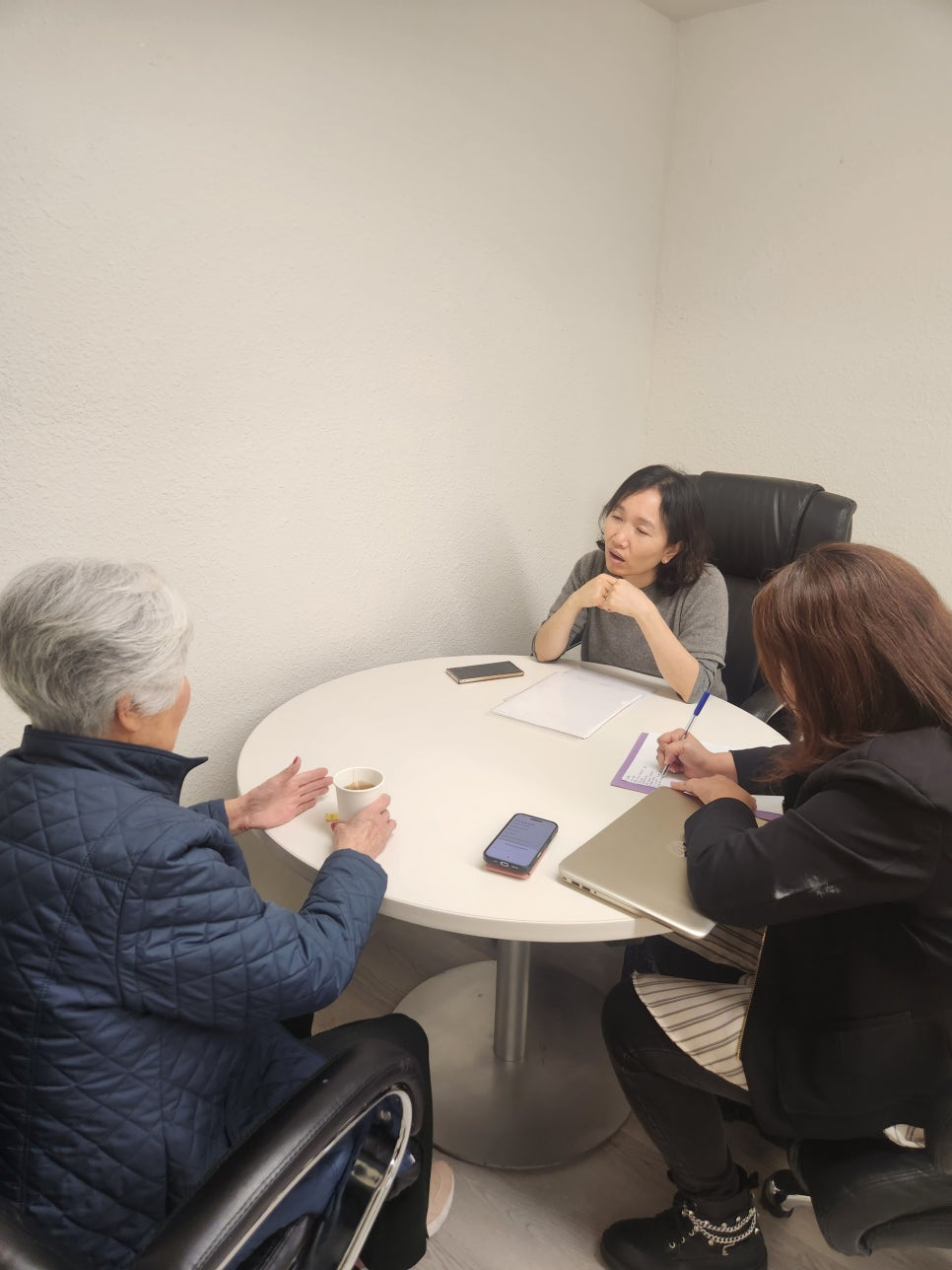
2. Interviews
- Individual interviews
- Additional interviews
<Bae>**
That illness comes suddenly, you know. That was actually a signal in everyday life, but this person said their stomach was bad. After they passed away, I found out that those things were all zero.
When I looked it up, that was heart disease. That pain behind the chest.
Yes.
<Park>**
If this person is hurting like this now, then this situation does not match at all, it does not fit.
The only thing that came to me loudly was that he was dying.
When I think about it, he gave me the greatest gift, and even though I married and divorced several times, I realized that this person truly was my husband.
<Gu>**
“These days, I also read books. So really, every single day, I am happy.”
“Hey, you know what, write this down for me. ‘I lived one life having a really good time before I go.’ Mom has absolutely no regrets. Anytime. Even if Mom goes. ‘I lived one life having a good time before I go.’ That is my goal.”
<Lee>**
“So I invited my mother. During the last six months of my PhD, my mother stayed with me. If I went to the computer lab at night, she followed me to the library and did that, protecting me. After I graduated, I said I would show her America, so I drove around. I was so brave, without even a map.”
“I made kimchi myself. When school ended, I went to the market. Back then, there was no refrigerator or anything like that. So I would stop by the market, buy groceries, carry my bag, and in the summer I made kimchi every day.”
That sounds like a really interesting project! I’m fascinated to hear about incorporating personal stories into the performance.